
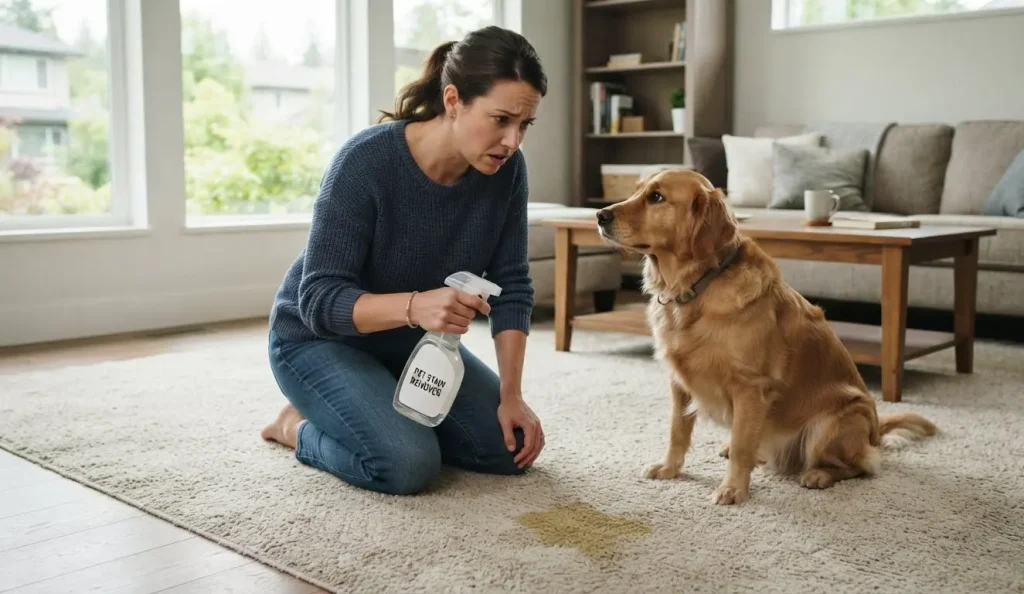
If you have ever cleaned a pet stain thoroughly only to find the smell returning days or weeks later, you are not doing anything wrong. Why does pet smell come back after cleaning is one of the most common questions pet owners ask carpet cleaning professionals across the Lower Mainland. The answer has nothing to do with how hard you cleaned or which product you used. It has everything to do with what is happening deep inside your carpet where no surface cleaner can reach.
This guide explains the science behind why pet smell keeps returning, what is actually happening inside your carpet fibres and underlay, and what permanently eliminates the problem rather than masking it temporarily.
The Real Reason Why Pet Smell Comes Back After Cleaning
Understanding why does pet smell come back after cleaning starts with understanding what pet urine actually is and what happens to it after it soaks into your carpet.
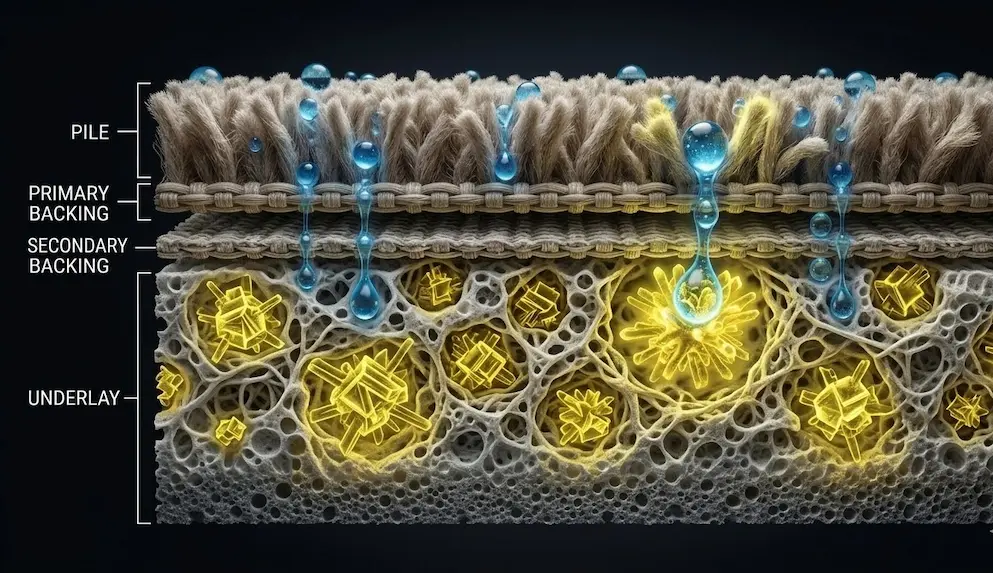
Pet urine is not just liquid. It contains water, urea, proteins, bacteria, and most importantly uric acid. When your pet has an accident on carpet, the liquid immediately begins soaking downward through gravity. Within seconds it penetrates the carpet pile. Within a minute or two it passes through the carpet backing. From there it spreads horizontally through the underlay beneath, which absorbs liquid like a sponge. In severe cases it reaches the subfloor beneath the underlay.
The visible stain on the surface of your carpet is almost always significantly smaller than the actual contaminated area beneath it. This is the first reason why does pet smell come back after cleaning. You treated the surface but the contamination was never just on the surface.
| What Pet Urine Contains | Why It Matters |
|---|---|
| Water | Carries contamination deep into carpet layers |
| Urea | Breaks down into ammonia as it ages |
| Proteins | Feed bacteria growth inside carpet and underlay |
| Bacteria | Produce odour compounds continuously |
| Uric acid | Forms insoluble crystals that reactivate with moisture |
Uric Acid Crystals — The Main Reason Pet Smell Returns
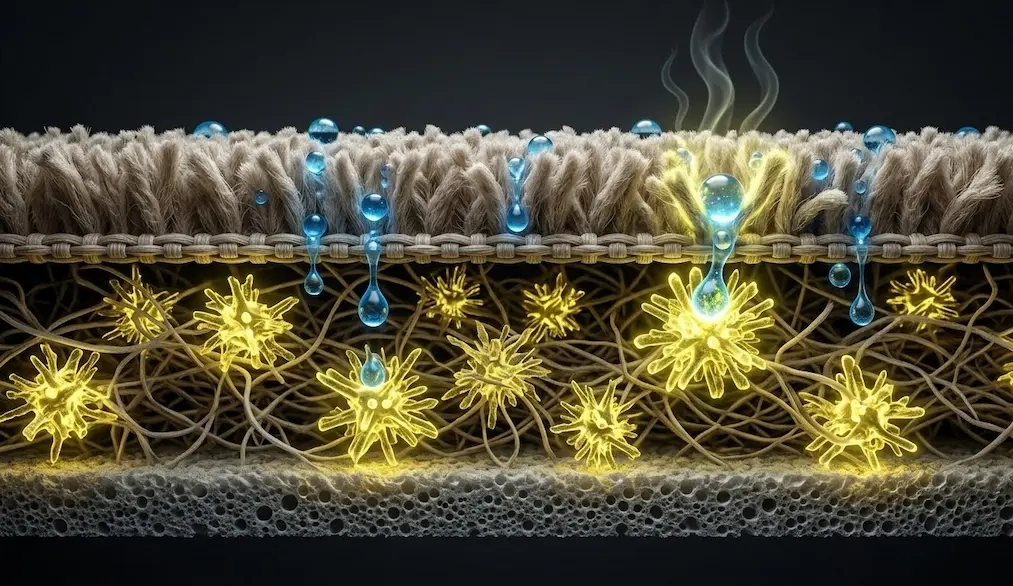
This is the core answer to why does pet smell come back after cleaning and it is something most home cleaning methods simply cannot address.
As pet urine dries, the uric acid component does not evaporate with the water. Instead it crystallises and bonds to carpet fibres and underlay material. These uric acid crystals are insoluble in water which means they cannot be dissolved or removed by water-based cleaning solutions, standard carpet shampoos, baking soda, vinegar, or even hot water extraction if enzyme pre-treatment was not applied first.
The crystals themselves are relatively odourless when completely dry. This is why a cleaned carpet can smell fine immediately after treatment and even for several days afterwards. The problem occurs when moisture is reintroduced. When uric acid crystals absorb moisture they rehydrate and begin releasing gaseous ammonia and other volatile compounds that produce the sharp distinctive pet odour. This is the biological mechanism behind why does pet smell come back after cleaning in every case where uric acid crystals were not fully eliminated.
| Uric Acid Crystal Behaviour | What Happens |
|---|---|
| When completely dry | Relatively odourless, dormant |
| When exposed to moisture | Rehydrates and releases ammonia and volatile compounds |
| After surface cleaning only | Crystals remain in underlay, reactivate with any moisture |
| After enzyme treatment | Crystals are broken down biologically and permanently eliminated |
Why Langley BC and Lower Mainland Homes Have It Worse
This is the local angle that makes why does pet smell come back after cleaning a particularly persistent problem for Lower Mainland pet owners compared to homeowners in drier parts of Canada.
The Lower Mainland wet season runs from October through March bringing consistently high indoor humidity throughout those six months. Unlike Calgary or other prairie cities where winters are dry and uric acid crystals remain dormant for months at a time, Langley BC homes maintain elevated humidity levels almost year round.
This means uric acid crystals in Langley BC carpets are being continuously exposed to moisture-rich air throughout the wet season. Rather than sitting fully dormant until a cleaning event reactivates them, they are experiencing repeated low-level reactivation from ambient humidity on an ongoing basis. The result is that pet odours in Langley BC homes tend to be more persistent and more difficult to fully eliminate than in drier Canadian climates.
| Lower Mainland Climate Factor | Impact on Pet Odour |
|---|---|
| Wet season October to March | Continuous ambient humidity reactivates crystals repeatedly |
| Year round mild temperatures | Bacteria in carpet remain active longer than in cold climates |
| Airtight modern home construction | Traps humidity indoors, worsening crystal reactivation |
| Summer temperature and humidity combined | Double trigger for crystal reactivation in warmer months |
The Wicking Effect — Why Cleaning Sometimes Makes the Smell Worse
Many Langley BC pet owners notice that after cleaning a pet-stained carpet the smell actually gets worse before it gets better. This is called the wicking effect and it is a direct answer to why does pet smell come back after cleaning, specifically why it seems to intensify immediately after treatment.
When a carpet is cleaned without proper enzyme pre-treatment, the cleaning moisture penetrates downward into the underlay where the uric acid contamination lives. As the carpet dries, moisture is drawn back upward through the carpet fibres toward the surface through capillary action. This upward movement carries dissolved contamination from the underlay with it, concentrating it at the surface of the carpet where it is far more detectable than when it was dispersed throughout the underlay.
This wicking effect explains why a carpet that smelled mildly of pet odour before cleaning can smell significantly worse for the first few days after cleaning. The contamination did not get worse. It simply moved from being dispersed deep in the underlay to being concentrated at the surface.
Preventing wicking requires enzyme pre-treatment to be applied and allowed to fully dwell before any moisture is introduced through hot water extraction. Once the uric acid has been enzymatically broken down, there is no contamination left to wick upward during drying.
Why Store-Bought Products Cannot Permanently Fix Pet Smell
Understanding why does pet smell come back after cleaning also requires understanding what store-bought products actually do compared to what they cannot do.
Most consumer pet odour products work through one of three mechanisms. Fragrance masking adds a stronger smell on top of the pet odour. Baking soda and similar absorbents neutralise surface pH. Dilution with water-based solutions reduces the surface concentration of contamination temporarily.
None of these mechanisms address uric acid crystals in the underlay. This is why the smell always returns after home treatment. The product worked on the surface. The source was never the surface.
| Product Type | What It Does | Why Smell Returns |
|---|---|---|
| Fragrance sprays | Masks odour temporarily with stronger scent | Fragrance fades, uric acid crystals remain |
| Baking soda | Neutralises surface pH | Does not reach crystals in underlay |
| Vinegar solution | Dilutes surface contamination | Cannot dissolve uric acid crystals |
| Store-bought enzyme spray | May partially address surface crystals | Often insufficient volume to reach underlay |
| Professional enzyme treatment | Fully saturates carpet and underlay, breaks down all crystals | Permanent elimination when correctly applied |
What Enzyme Treatment Actually Does and Why It Works
The permanent answer to why does pet smell come back after cleaning is enzyme treatment applied correctly and in sufficient volume to reach all contamination.
Enzyme cleaners contain biological enzymes, primarily protease and urease, that chemically digest uric acid compounds at a molecular level. The enzymes break the molecular bonds of uric acid converting it into carbon dioxide and water which then evaporate completely. Once uric acid has been enzymatically digested there is literally nothing left to reactivate.
According to the IICRC industry cleaning standards, effective pet urine treatment requires sufficient enzyme product to fully penetrate all contaminated layers including carpet pile, backing, and underlay. This is the most critical factor in permanent odour elimination. Applying insufficient product so that only the surface is treated leaves deep crystals intact and the smell will return.
The Health Canada also notes that biological contaminants including bacteria from pet accidents are a significant contributor to poor indoor air quality. Enzyme treatment addresses both the odour and the bacterial component simultaneously.
| Enzyme Treatment Factor | Why It Matters |
|---|---|
| Sufficient volume applied | Must reach underlay to address deep crystals |
| Correct dwell time minimum 15 minutes | Enzymes need time to fully digest uric acid |
| Applied before hot water extraction | Prevents wicking of undigested contamination |
| Professional grade concentration | More effective than consumer products at breaking down crystals |
| Post-treatment extraction | Removes digested compounds and enzyme solution completely |
How to Use a UV Blacklight to Find All Pet Contamination
One of the most practical tools for addressing why does pet smell come back after cleaning is a UV blacklight. Pet urine fluoresces under ultraviolet light, making contaminated areas visible even when completely dry and invisible under normal lighting.
This matters because the contaminated area is almost always larger than the visible stain. When treating only the visible spot you inevitably leave surrounding contaminated areas untreated. Those untreated areas continue to reactivate and produce odour even after the main visible stain has been addressed.
To use a UV blacklight effectively turn off all lights and close curtains to make the space as dark as possible. Move the UV light slowly across the carpet surface at a low angle. Contaminated areas will appear as yellow or green glowing patches. Mark the boundaries of each contaminated area before treating to ensure full coverage.
When the Underlay Needs to Be Replaced
In some cases the answer to why does pet smell come back after cleaning is that the underlay itself is so saturated with contamination that no amount of surface or even professional treatment can fully address it.
Signs that underlay replacement may be necessary include persistent odour that returns despite multiple professional treatment cycles, large areas of visible discolouration when the carpet edge is lifted, structural softening of the underlay material, and odour that consistently intensifies during Langley BC’s wet season beyond what treatment is resolving.
When underlay replacement is required the correct process is to lift the carpet, remove and dispose of contaminated underlay, treat the subfloor with an oil-based sealant to lock in any remaining odour, install new underlay, and relay or replace the carpet. This is a more significant intervention but it permanently resolves the problem in cases where the contamination has simply exceeded what cleaning alone can address.
Professional Pet Odour Removal vs DIY — Why the Difference Matters
| Factor | DIY Treatment | Professional Treatment |
|---|---|---|
| Volume of enzyme product applied | Usually insufficient to reach underlay | Sufficient volume to fully saturate all layers |
| UV detection used | Rarely | Standard pre-inspection procedure |
| Dwell time controlled | Often rushed | Minimum 15 to 30 minutes strictly observed |
| Extraction power | Home machines leave significant moisture behind | Truck-mounted extraction removes maximum moisture |
| Wicking prevention | Not addressed | Enzyme pre-treatment applied before any moisture |
| Underlay assessment | Not possible without lifting carpet | Professional assessment included |
| Permanent result | Rarely achieved | Consistent when correctly applied |
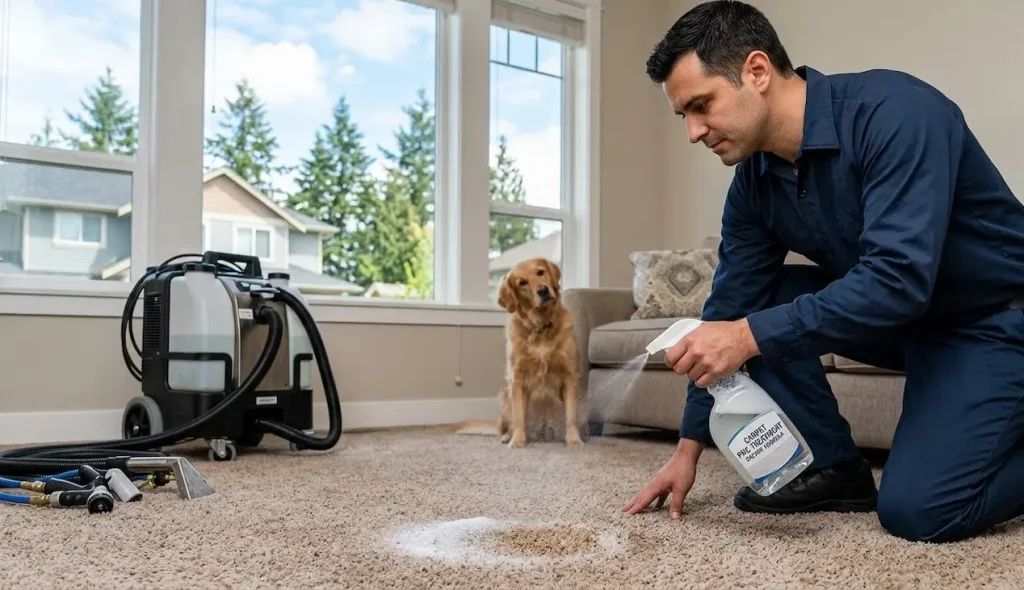
At Prime Carpets Clean our stain and odour removal service uses professional grade enzyme treatment applied in sufficient volume to fully saturate all contaminated layers. Every job begins with a UV blacklight pre-inspection to identify the full extent of contamination before any treatment begins.
We also provide residential carpet cleaning for pet owner households across Langley BC and offer specialist area rug cleaning for rugs that have been affected by pet accidents and require careful fabric-specific treatment.
Frequently Asked Questions
Why does pet smell come back after cleaning even when I used enzyme cleaner?
The most common reason is insufficient volume of enzyme product. The product must fully saturate the carpet down to the underlay to reach all uric acid crystals. If only the surface was treated the deep crystals remain intact and reactivate with moisture. A second reason is insufficient dwell time. Enzymes need a minimum of 15 minutes to fully digest uric acid compounds before extraction.
Why is pet smell worse in wet weather in Langley BC?
Uric acid crystals absorb moisture and release odour compounds when they rehydrate. During Langley BC’s wet season from October through March the consistently high ambient humidity continuously reactivates dormant crystals. This is why pet smells that seem to have been resolved return or intensify every time the weather turns wet.
Does steam cleaning make pet smell worse?
Sometimes initially yes. Hot water extraction without enzyme pre-treatment can cause the wicking effect where contamination from the underlay is drawn upward to the carpet surface during drying. This temporarily concentrates the odour at the surface. Using enzyme pre-treatment before any extraction prevents this from happening.
How do I know if my carpet underlay needs replacing?
If pet odour returns consistently despite multiple professional treatment cycles, if you can see large areas of discolouration when lifting the carpet edge, or if the underlay feels soft or damaged, replacement is likely necessary. A professional technician can assess underlay condition during a pre-inspection.
Can old dried pet stains be permanently removed?
Yes in most cases. Old dried uric acid crystals respond to professional enzyme treatment even after months or years. The key is applying sufficient product volume and dwell time to fully digest all crystals. Very severe or layered contamination from repeated accidents in the same spot may require multiple treatment cycles.